
Data 360 Consultant

The Data 360 Consultant Certification is designed for consultants with significant experience in implementing and consulting on enterprise data platforms, particularly in customer-facing roles that involve designing, configuring, and architecting solutions. This guide is intended to prepare you for the Data 360 Consultant Exam. A Data 360 Consultant is responsible for ensuring that customer business requirements are met in a scalable and maintainable way, contributing to the long-term success of the customer. Individuals seeking to validate their expertise in Data 360 should consider pursuing this certification.
Key facts
This information will assist you if you’re interested in becoming Data 360 Consultant certified and includes an overview of the core topics in the exam.
There are 6 areas of knowledge that are covered by the Salesforce Data 360 Consultant certification.
| Objective | Weighting |
|---|---|
| Solution Positioning | 14% |
| Data 360 Setup and Administration | 13% |
| Data Source Connection and Ingestion | 18% |
| Harmonization and Unification | 17% |
| Data Enhancements, Sharing, and Analysis | 18% |
| Data Activations and Utilization | 20% |
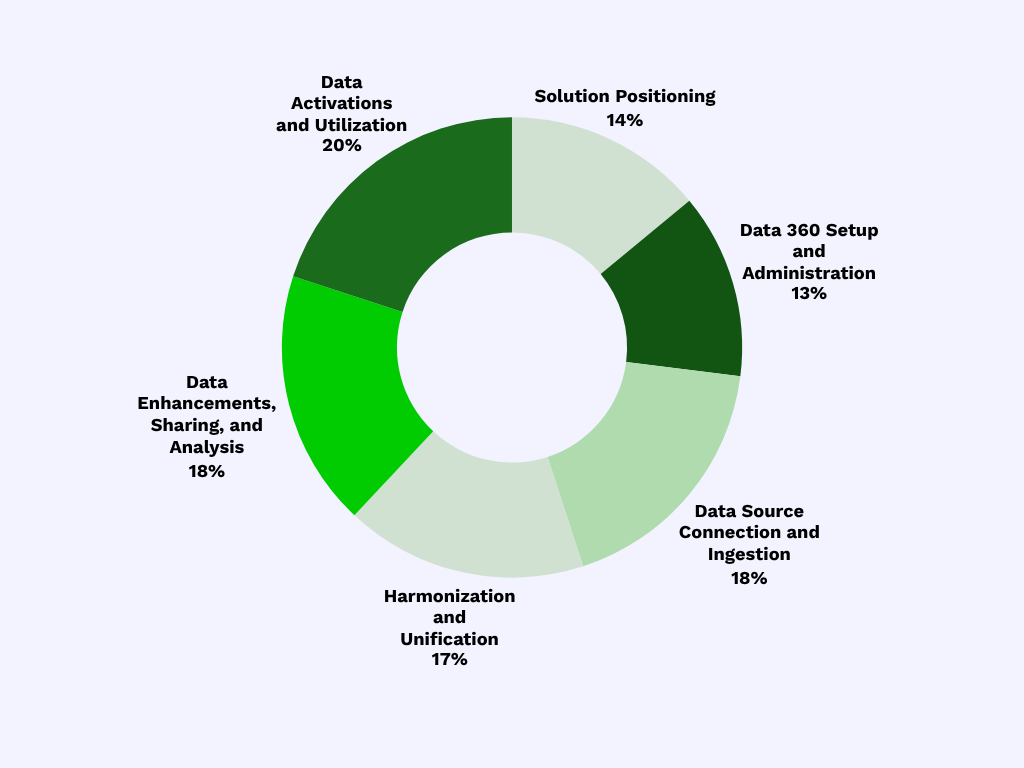
Data 360 Consultant Topic Weighting Chart
Data 360 Consultant certification contents
The following are the core topic areas of the Data 360 Consultant certification and what candidates are expected to know:
Solution positioning
This topic includes the following objectives:
Describe the key terminology and business value of Data 360.
The vocabulary is tested directly, so candidates need to be fluent in data streams, data lake objects, data model objects, data spaces, identity resolution, unified profiles, calculated insights, data graphs, segments, and activations. They also need the business translation: one trusted view of a customer, assembled from systems that were never designed to talk to each other, and made available to every Salesforce application in near real time.
Articulate the foundational role Data 360 plays in generative and predictive AI.
An AI project is usually a data project first. Data 360 supplies the grounding that makes a generative response specific to a real customer, and the harmonized, unified data that predictive models are trained on and scored against. Candidates should be able to explain to a customer why the data work comes before the AI work.
Identify initial use cases for Data 360.
Consultants are expected to choose a first project that proves value quickly. Familiar starting points include building a single view of the customer across CRM and external systems, sharper segmentation for marketing, giving service agents a complete order and engagement history, and reporting that spans systems. The right answer usually matches the customer’s stated priority against the data that is realistically available.
Describe the principles of data ethics and governance.
Bringing customer data together raises the question of what should be brought together. Candidates should understand consent and privacy obligations, transparency with customers about how their data is used, collecting only what a use case needs, and the platform controls that classify sensitive data and limit who can work with it.
Data 360 setup and administration
This topic includes the following objectives:
Configure Data 360 permissions, permission sets, and organization-wide settings.
Access is granted through Data 360 permission set licenses and permission sets, which separate administrators from the people who build segments or consume profiles, layered on top of the standard Salesforce permission model. Candidates should also understand data spaces, which partition data by brand, region, or business unit, and what that partitioning means for the data a user can see, segment, and activate.
Apply data governance requirements to the platform configuration.
Governance turns into configuration decisions. That covers classifying fields by sensitivity, deciding which data is mapped and made available for segmentation and activation, respecting consent when data is used, and handling deletion requests. Candidates should be able to take a policy requirement and point to the setting that enforces it.
Manage the development lifecycle with the available tooling.
Data 360 configuration has to move between environments like any other build. Candidates should know how data kits package objects and related components for deployment and reuse, how sandbox and production environments fit together, and how to sequence a release so that streams, mappings, and identity resolution land in an order that works.
Use tooling to diagnose and troubleshoot common issues.
Most problems surface in a small number of places: a data stream that failed or is running behind, a mapping that leaves a field empty downstream, an identity resolution ruleset that produces too many or too few unified profiles, a segment returning no members, or an activation that did not publish. Candidates should know where to look, including data stream and refresh history, Data Explorer and Profile Explorer, and the job and usage monitoring in the app.
Data source connection and ingestion
This topic includes the following objectives:
Explain the data transformation capabilities within Data 360.
Transformation happens at more than one point. Formula fields on a data stream handle light cleanup as data arrives. Batch data transforms build new data lake objects from existing ones on a schedule, and streaming transforms do comparable work on data as it lands. Candidates should know which tool suits a requirement and what each one produces.
Describe the processes and considerations for ingesting data from varied sources.
Data arrives through connectors for Salesforce CRM and Marketing Cloud, cloud storage such as Amazon S3, Google Cloud Storage, and Azure, the Ingestion API in both bulk and streaming form, and the web and mobile SDKs that capture behavioral data. Each data stream needs a category of profile, engagement, or other, a primary key, and an event time field for engagement data, along with a refresh approach such as full refresh or upsert. Candidates should weigh data volume, how fresh the data needs to be, and the consumption each choice drives.
Describe the data collaboration capabilities of Data 360, including Zero Copy.
Zero Copy lets Data 360 work with data that stays where it is, in a lakehouse such as Snowflake, Databricks, BigQuery, or Redshift, surfaced as external data lake objects rather than ingested. Sharing runs in the other direction too, making Data 360 objects available to those platforms without exporting files. Candidates should be able to argue the trade-off: no duplication and no ingestion of that data, weighed against query performance and the limits on what external objects support.
Harmonization and unification
This topic includes the following objectives:
Define the purpose, the process, and the supported use cases of unification.
Unification resolves records that describe the same person or account into a single profile. An identity resolution ruleset pairs match rules, which decide when two records represent the same entity, with reconciliation rules, which decide which value survives when matched records disagree. Candidates should understand exact and fuzzy matching, normalization, how source priority and recency shape reconciliation, and the fact that rulesets run on a schedule, so a change takes effect on the next run.
Model data in Data 360.
Modeling means mapping data lake objects to data model objects so that data from different systems lands in a shared shape. Candidates should know the standard data model, when a custom data model object is justified, how relationships between objects are defined, and how a mapping decision carries through to identity resolution, insights, segmentation, and activation. Weak mapping rarely fails loudly. It shows up later as a segment that returns nothing.
Data enhancements, sharing, and analysis
This topic includes the following objectives:
Demonstrate how to enhance data and build insights on unified data.
Calculated insights run on a schedule and turn unified data into metrics such as lifetime value, order frequency, or an engagement score, and those metrics can then be used in segments and activations. Streaming insights work on data as it arrives and can trigger action immediately. Data graphs pre-assemble related data into a single cached structure so it can be retrieved quickly, which is what makes real-time personalization and AI grounding practical.
Explain how to reference Data 360 data from other systems.
Unified data is more useful where people already work. Data 360 data can appear on CRM record pages through related lists and components, be queried through the Query API by external applications, and be shared with analytics platforms without another copy. Candidates should match the method to the system that needs the data.
View and build reports and dashboards using Data 360.
Reporting options include Salesforce reports and dashboards built on data model objects, calculated insights surfaced in dashboards, and analytics tools such as CRM Analytics and Tableau connecting to Data 360. Candidates should know which option queries the data in place and which requires it to be brought into the org, and choose based on volume and how current the numbers need to be.
Apply the predictive and generative AI capabilities of Data 360 to customer scenarios.
Model Builder brings predictive models into Data 360, either built there or connected from an external platform, with scores written back so they can be used in segments, flows, and activations. On the generative side, Data 360 grounds prompt templates and agents in customer data, including unstructured content that has been indexed for search. Candidates should be able to say which of the two a scenario actually calls for.
Data activations and utilization
This topic includes the following objectives:
Define the basic concepts of segmentation and its use cases.
A segment is a rule-based population built on a data model object, most often the unified individual. Candidates should know how filters on direct attributes, related attributes, and calculated insights combine, how containers and nested segments structure the logic, and how membership is refreshed on a publish schedule rather than recalculated on every change.
Manage segments within Data 360.
Segments need attention after they are built. That means publish schedules and manual publishes, checking membership counts against expectations, reusing logic through nested segments rather than rebuilding it, and watching the consumption that frequent refreshes drive. Candidates should be able to explain why a count moved or why expected members never appeared.
Publish activations within Data 360.
An activation sends segment members to a target such as Marketing Cloud, an advertising audience, cloud storage, or back into Salesforce CRM. Configuring one means choosing the activation target, the contact points that identify the person on that channel, the attributes and related attributes to send, and any consent that has to be honored. Candidates should know what happens on each publish and how to work back through a failure.
Act on data.
Not every response should wait for the next segment refresh. Data actions send an event to a target such as Marketing Cloud, a platform event in the org, or a webhook, typically driven by a streaming insight or a change in the data, so the business can respond while the moment still matters.
Use Data 360 in Salesforce flows.
Flows are how unified data reaches everyday sales and service processes without code. Data 360 data can be retrieved inside a flow, and flows can be triggered by changes to Data 360 data or by an insight condition. Candidates should be able to design an automation that combines Data 360 as the source of truth with the platform’s standard automation tools.