Marketing Cloud Next Consultant

The Salesforce Certified Marketing Cloud Next Consultant exam is built for practitioners who implement and configure Marketing Cloud Next in consulting or customer-facing roles. It tests whether a candidate can design data-first marketing solutions on the Salesforce platform and Data 360, build multi-channel campaigns with Flow and Agentforce, and recommend the right Marketing Cloud Next architecture for a customer’s business.
Salesforce recommends 6 to 12 months of hands-on experience implementing or administering Marketing Cloud Next before sitting the exam. Consultants who want to validate their ability to deliver Marketing Cloud Next for small business and enterprise customers should consider this certification.
Key facts
This information will assist you if you’re interested in becoming certified Marketing Cloud Next Consultant and includes an overview of the core topics in the exam.
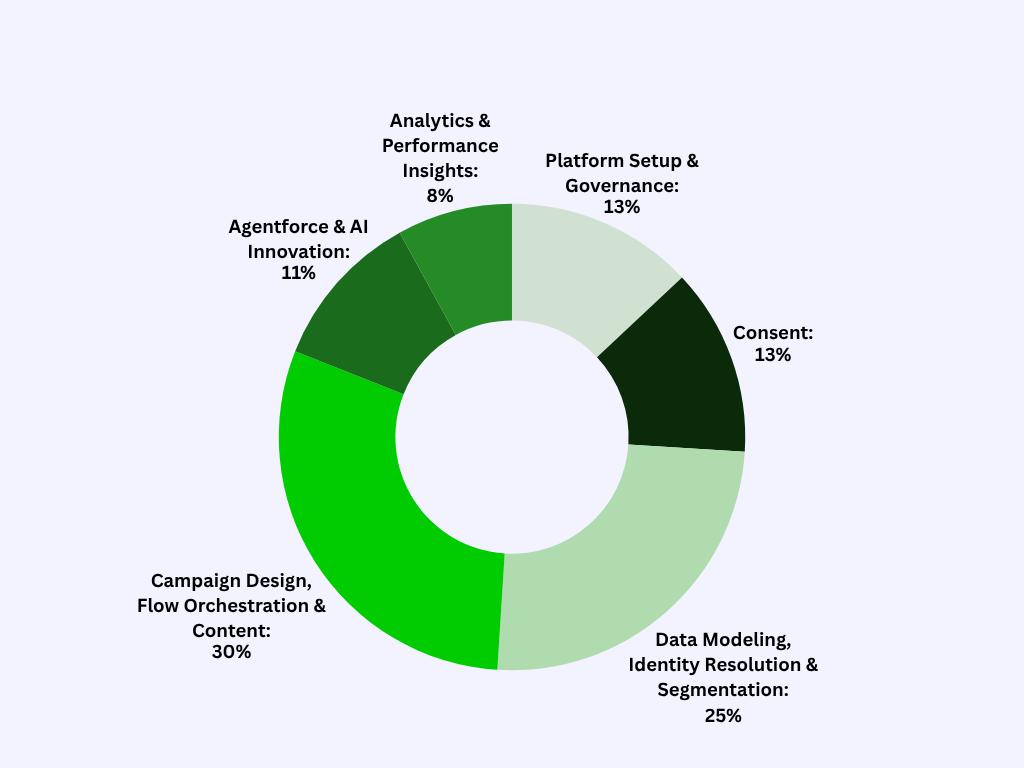
There are 6 areas of knowledge covered by the Salesforce Certified Marketing Cloud Next Consultant certification.
| Objective | Weighting |
|---|---|
| Platform Setup & Governance | 13% |
| Consent | 13% |
| Data Modeling, Identity Resolution & Segmentation | 25% |
| Campaign Design, Flow Orchestration & Content | 30% |
| Agentforce & AI Innovation | 11% |
| Analytics & Performance Insights | 8% |
Marketing Cloud Next Consultant Weighting Chart
Marketing Cloud Next Consultant certification contents
The following are the core topic areas of the Marketing Cloud Next Consultant certification and what you’re expected to know:
Platform setup and governance
This topic includes the following objectives:
Explain how a Marketing Cloud Next environment is set up, including core org edition requirements, Data 360 provisioning, installing the Marketing Data Kit, and permission sets.
Marketing Cloud Next runs on the core Salesforce platform. It comes in Growth and Advanced editions and requires Salesforce Enterprise or Unlimited Edition. Setup follows a set order: provision Data 360, install the data kits that deploy the marketing data streams, then assign permission sets so each user can reach the right campaigns, content, and data. Candidates should know which steps depend on others.
Given a scenario, determine whether Business Units are needed and set up a governance model for content and users with roles and Enhanced CMS Workspaces.
Business Units let a single org serve separate brands, regions, or divisions. Each Business Unit has a one-to-one relationship with a Data Space, which is how data stays isolated between units. Governance then covers who can create, edit, and publish content, using roles, CMS workspaces, and common assets that share approved content across units. The exam tests when one unit is enough and when separation is required.
Given a scenario, set up self-service domain authentication or domain authorization so branded email is delivered and authenticated.
Deliverability starts with the sending domain. Consultants authenticate and configure domains in Unified Messaging so messages pass DKIM and SPF checks and carry the customer’s brand. The exam guide also references automated guardrails for scaling dedicated IPs, so candidates should understand how sender reputation is protected as sending volume grows.
Consent
This topic includes the following objectives:
Explain consent management concepts and the part consent plays in customer engagement and compliance.
Marketing Cloud Next checks consent before it sends. A consent check requires a communication subscription on each send and delivers only to recipients who have opted in. Consent is required for promotional email and for every SMS, WhatsApp, and RCS message, while consent checks for transactional email are off by default. Consent is stored against the contact point value, such as an email address or phone number, rather than the Unified Individual record.
Identify what each platform consent object does and how the objects relate to each other.
Four objects work together to store consent: Communication Subscription (the type of content someone signs up for, such as product updates), Engagement Channel Type (email, SMS, RCS, and so on), Communication Subscription Channel Type (which connects a subscription to a channel), and Communication Subscription Consent (the record of a person’s consent). Candidates should be able to trace how a single opt-in touches each object.
Given a business requirement, choose the right way to create, manage, and update consent records.
The options include the Consent tab, which Salesforce recommends as the default; Preference Manager, for orgs that need more customization; preference pages, where subscribers manage their own choices; consent data imports; and the Create Consent flow action, which updates consent automatically after a form submission or link click. Double opt-in is built in Flow Builder by capturing the form, sending a confirmation email, and storing explicit consent.
Given a scenario, set up a consent banner on Marketing Cloud Next landing pages and on external pages to collect consent.
Web activity tracking depends on visitor consent. Consultants configure the consent banner for landing pages built in Marketing Cloud Next and for external sites where tracking is set up, so visitor activity is recorded only where consent has been given.
Data modeling, identity resolution, and segmentation
This topic includes the following objectives:
Describe Data 360 data object concepts and how they connect, harmonize, unify, and activate customer data for segmentation and content personalization.
Data enters Data 360 through data streams and lands in data lake objects (DLOs). It is mapped to data model objects (DMOs) to harmonize it, unified through identity resolution, and then used in segments, activations, and personalization. The exam also expects candidates to troubleshoot this pipeline by confirming that data is actually populating the DMOs.
Given a business requirement, identify how CRM data, including objects, records, and Actionable Lists, is brought in and used for segmentation, activation, and personalization.
For many customers, the core audience already lives in CRM as leads, contacts, and accounts. Consultants need to know how CRM objects and records reach Data 360 and how Actionable Lists fit alongside segments as a way to build and act on an audience.
Given a business requirement, set up identity resolution to link several data sources into one unified profile.
Identity resolution rulesets use match rules to decide which source profiles belong to the same person and reconciliation rules to decide which value to keep when sources disagree. The output is the Unified Individual, which drives segmentation, consent checks, and personalization.
Show an understanding of Data 360 consumption-based entitlements and assess how marketing automation design affects consumption and usage.
Data 360 is billed on usage, tracked through the org’s licenses and Digital Wallet. Choices such as ingestion volume, segment refresh frequency, and how often flows run can all affect consumption. Candidates should be able to spot designs that use more capacity than the business outcome needs.
Campaign design, Flow orchestration, and content
This topic includes the following objectives:
Given a scenario, identify personalization methods, including Handlebars, AMPscript, merge fields, repeaters, and content variations, to personalize channel content with customer data.
Merge fields insert profile or related data. Content variations show different content to different audiences. Repeaters loop through a set of related items, such as product recommendations. Handlebars adds logic inside content, and AMPscript appears in the objective, though the exam guide states that candidates are not expected to write raw AMPscript. A consultant should pick the simplest method that meets the requirement.
Given a scenario, choose the flow type, trigger conditions, and configuration settings needed for the marketing or messaging outcome.
Marketing Cloud Next supports several flow types. Audience flows target segment, list, or campaign members and run immediately, once, or on a recurring schedule as often as hourly. Automation event-triggered flows respond to events such as a form submission, typically within about 15 minutes. Activation-triggered flows run when an activation is published. Broadcast flows evaluate dynamic segment membership when they start and are launched by API, Apex, or another flow. On-demand flows handle high-priority sends such as order confirmations.
Given a scenario, choose the right data source for adding personalized customer data to messages.
Personalization can draw on profile attributes, related records, and data graphs set up for personalization. The data source determines which fields are available when a message is built and sent, so the choice needs to match the use case.
Given a scenario, identify the flow elements, logic, and configuration needed to automate business processes and messaging.
Flow Builder includes elements built for marketing, such as sending email and SMS messages, waiting, branching with decisions, and creating consent. Candidates should be able to read a requirement and select the elements and logic that deliver it.
Given a scenario, configure activation templates to select the correct contact point value.
A Unified Individual can hold several email addresses or phone numbers. Contact point settings and source priority order in the activation decide which objects and fields are included, and therefore which value receives the message.
Given a business requirement, identify the components and configuration needed to build a landing page.
Landing pages are built from templates and components and commonly include a form. Configuration covers SEO page properties, URL details, reCAPTCHA protection for forms, and the tracking and consent settings that apply to the page.
Agentforce and AI innovation
This topic includes the following objectives:
Given a scenario, use marketing agents to automate campaign creation, audience segmentation, and content generation.
The Campaign Creation Agent drafts briefs, campaigns, and content, including email subject lines, preheaders, landing pages, and SMS messages, from conversational prompts. Segment Creation drafts audiences for campaigns. Both must be enabled in Setup, and marketing agents run on the Agentforce Employee Agent type.
Given a scenario, set up conversational messaging to handle customer engagement, responses, and ongoing interactions across messaging channels.
Conversational marketing uses AI agents to hold two-way conversations with customers over SMS, email, and WhatsApp. Consultants should understand how these conversations are configured, from the first outbound message through replies and follow-up.
Given a scenario, choose which predictive AI feature to use.
Marketing Cloud Next includes four predictive Einstein features. Send Time Optimization delivers email at the time each recipient is most likely to engage. Engagement Frequency sets how often to message each contact. Engagement Scoring predicts opens, clicks, retention, and web conversion. Metrics Guard filters out opens and clicks that are unlikely to be real, such as those generated by mailbox providers and email scanners. Engagement Scoring and Engagement Frequency require the Advanced edition.
Analytics and performance insights
This topic includes the following objectives:
Given a scenario, identify the pre-built dashboard that best meets a reporting and analytics requirement.
Reporting in Marketing Cloud Next is powered by Data 360 and Tableau Next. Analytics dashboards on the Analytics tab can be used as-is or customized. Marketing Performance Intelligence measures performance across paid, owned, B2B, and offline channels. B2B Analytics for Marketers connects campaign activity to pipeline and revenue, and Unified Engagement History dashboards can also be turned on. Candidates should be able to match a requirement to the right option.
Given a scenario, describe how to surface marketing data and insights across the Salesforce platform.
Because Marketing Cloud Next runs on the same platform as Sales Cloud and Service Cloud, marketing insights can sit alongside CRM data in standard reports and dashboards. Opportunity influence attributes revenue to specific campaigns, giving sales and marketing a shared view of results.
To prepare for the certification exam, we recommend working through our Marketing Cloud Next Consultant Practice Exams