Revenue Management Consultant

The Salesforce Certified Agentforce Revenue Management Consultant Exam is designed for individuals who design and implement the Revenue Management product on core with capabilities across Product-to-Cash, particularly in customer-facing roles that involve designing, configuring, and architecting solutions. This guide is intended to prepare you for the Salesforce Certified Agentforce Revenue Management Consultant Exam. An Agentforce Revenue Management Consultant is responsible for ensuring that customer business requirements are met in a scalable and maintainable way, contributing to the long-term success of the customer. Individuals seeking to validate their expertise in modern product-to-cash lifecycle solutions on core should consider pursuing this certification.
Key facts
This information will assist you if you’re interested in becoming a certified Agentforce Revenue Management Consultant and includes an overview of the core topics in the exam.
There are 7 areas of knowledge covered by the Salesforce Certified Agentforce Revenue Management Consultant certification.
| Objective | Weighting |
|---|---|
| Agentforce Revenue Management Platform Concepts | 18% |
| Implementation Readiness | 14% |
| Catalog Management | 16% |
| Configure, Price, Quote | 18% |
| Contracts and Orders | 11% |
| Asset Management | 16% |
| Invoice Management | 7% |
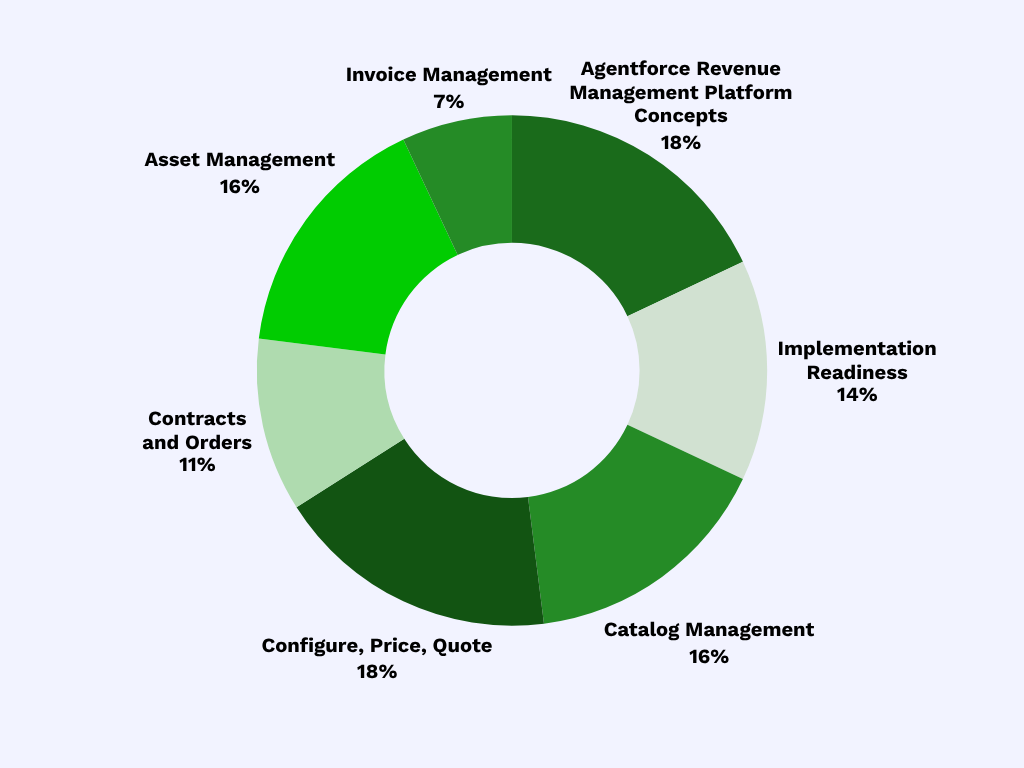 Agentforce Revenue Management Consultant Topic Weighting Chart
Revenue Management Consultant certification contents
The following are the core topic areas of the Revenue Management Consultant certification and what you’re expected to know:
Agentforce Revenue Management Platform Concepts
This topic includes the following objectives:
Explain how to configure foundational Salesforce features for Agentforce Revenue Management, including flows, Lightning page components, permission set licenses, and permission sets.
Setting up user access and system automation requires a strong grasp of core security framework components. You must configure Permission Set Licenses (PSLs) and individual permission sets to correctly distribute transactional capabilities, while implementing specialized Flows and customizing Lightning pages to unify the operational workspace.
Identify and describe Agentforce Revenue Management features, such as Context Service, Omnistudio, Business Rules Engine (BRE), and application programming interfaces (APIs).
Modern Revenue Cloud on core moves away from standalone package architectures to deep native tools. You will utilize Context Service to abstract and pull complex operational data, OmniStudio to deliver guided user flows, and the Business Rules Engine to evaluate logic rules, ensuring you know when to leverage native system APIs for external handshakes.
Design context-aware dashboards and key performance indicators (KPIs) using native Salesforce reporting tools.
To track and drive customer adoption, a consultant must design robust business analytics. This means building interactive dashboards and custom report types that calculate real-time quote-to-cash metrics, highlighting lead-to-invoice pipeline efficiency and transactional health.
Describe core Agentforce Revenue Management fields, objects, and relationships between objects.
The system maps its data flow cleanly across standard platform components. Understanding the underlying relationships among the product schema, indexing layouts, and transactional objects ensures data integrity as records progress through the product-to-cash ecosystem.
Implementation Readiness
This topic includes the following objectives:
Plan implementation readiness, including required licenses, permission sets, and prerequisite feature toggles.
Before writing a single piece of logic, you must validate environment status. This means checking user licensing, validating underlying features inside Setup, and turning on core platform toggles required for the Revenue Lifecycle Management layer to compute.
Assign roles and responsibilities to stakeholders for cross-product project execution.
Enterprise implementations touch multiple cross-functional departments. You must structure technical and business stakeholder maps cleanly, assigning responsibility across sales, deal desk, legal, and billing teams to keep standard multi-cloud alignments aligned.
Develop an Agentforce Revenue Management scope of work and project plan.
Managing delivery timelines demands a clear framework. You will author comprehensive scopes of work that accurately capture functional limits, establish implementation boundaries, and model milestones to guide successful cross-cloud outcomes.
Drive implementation through build, test, deployment, and adoption.
Moving successfully from a sandbox to an active environment requires rigorous oversight. You will lead teams dynamically through technical configuration, user acceptance testing (UAT), deployment migration windows, and post-launch user adoption phases.
Catalog Management
This topic includes the following objectives:
Explain Catalog Management core concepts and capabilities.
Product Catalog Management (PCM) establishes a single source of truth for all sellable items. You must master the foundational concepts of organizing components into clean catalogs, categories, dynamic product groupings, and product attribute definitions.
Given a scenario, implement a solution using the appropriate out-of-the-box Catalog Management functionality.
Faced with complex business requirements, a consultant must choose standard product configurations over custom code. This involves designing multi-level catalog systems, building classifications, and implementing attribute inheritance parameters to support diverse business lines.
Configure, Price, Quote
This topic includes the following objectives:
Use the Product Configurator tool to customize the components and attributes of a product and validate the configuration.
The native configurator allows users to construct personalized product models at the line-item level. You must design and build rules within the engine to enforce accurate configurations, making sure attributes change logically based on prior options selected.
Configure and apply pricing procedures to customer-specific business cases.
Advanced calculations execute through custom pricing models. You will configure native Pricing Procedures, feeding variables into Context Definitions and mapping Expression Sets via the Business Rules Engine to execute highly tailored tiers, matrix Lookups, or custom discounting loops.
Given a set of customer requirements, including using Agentforce, configure and generate an accurate pricing quote.
Sales operations are accelerated through modern artificial intelligence. You must apply business rules that utilize Agentforce Revenue Management tools, guiding users or automated workflows to calculate valid combinations and output clean quotes without manual friction.
Contracts and Orders
This topic includes the following objectives:
Given a scenario, configure Salesforce Contracts to meet business requirements.
Winning a transaction kicks off contractual relationships. You will apply configuration models to Salesforce Contracts, implementing standard clause protections, renewal agreements, and contract generation layouts that map perfectly to an enterprise’s legal operations workflow.
Given a scenario, configure Order Management to meet business requirements.
Transitioning a quote line into a legal order record requires a clean data structure. You must configure native workflows to process closed quotes into accurate order records, ensuring items split, combine, or line up perfectly for fulfillment routing down the line.
Asset Management
This topic includes the following objectives:
Explain Asset Management core concepts and capabilities.
Asset Lifecycle Management handles real-time data states of what a client has actively purchased. You must understand how the platform processes net-new asset creations, tracks asset value modifications, and logs state transitions over the duration of a customer relationship.
Given a scenario, implement a solution using the appropriate out-of-the-box Asset Management functionality.
Managing mid-term changes requires robust architecture. You will design and deploy out-of-the-box system paths to process Amendments (calculating pro-rated adjustments) and Renewals (automating contract lifecycle extensions), minimizing manual transactional overhead.
Invoice Management
This topic includes the following objectives:
Explain Invoice Management core concepts and capabilities.
Converting orders into financial ledgers requires strict process alignment. You must master how the platform automates invoicing, manages recurring charging profiles, links financial data fields, and establishes billing schedules.
Given a scenario, implement a solution using the appropriate out-of-the-box Invoice Management functionality.
Financial balance tracking must remain completely auditable. You will implement standard transactional setups to auto-generate invoices from orders, tracking payments, and handling reconciliation issues or balance changes using Credit and Debit Notes without corrupting historical ledger data.