




MuleSoft Developer
The Salesforce Certified MuleSoft Developer certification is designed for professionals who have experience working on basic Mule 4 projects with guidance and supervision. It validates the knowledge and skills needed to design, build, test, debug, deploy, and manage basic APIs and integrations using Anypoint Platform and Anypoint Studio.
Key facts
This page provides an overview of the knowledge and practical skills assessed in the Salesforce Certified MuleSoft Developer exam.
There are 12 areas of knowledge covered by the certification. Candidates should understand the concepts in each area and be able to apply the appropriate processors, interpret configuration and DataWeave syntax, and predict processing outcomes.
Data table
| Objective | Weighting |
| Creating Application Networks | 7% |
| Designing APIs | 8% |
| Accessing and Modifying Mule Events | 10% |
| Structuring Mule Applications | 10% |
| Building API Implementation Interfaces | 7% |
| Using Connectors | 10% |
| Processing Records | 10% |
| Transforming Data | 10% |
| Routing Events | 8% |
| Handling Errors | 8% |
| Debugging and Troubleshooting Mule Applications | 5% |
| Deploying and Managing APIs and Integrations | 7% |
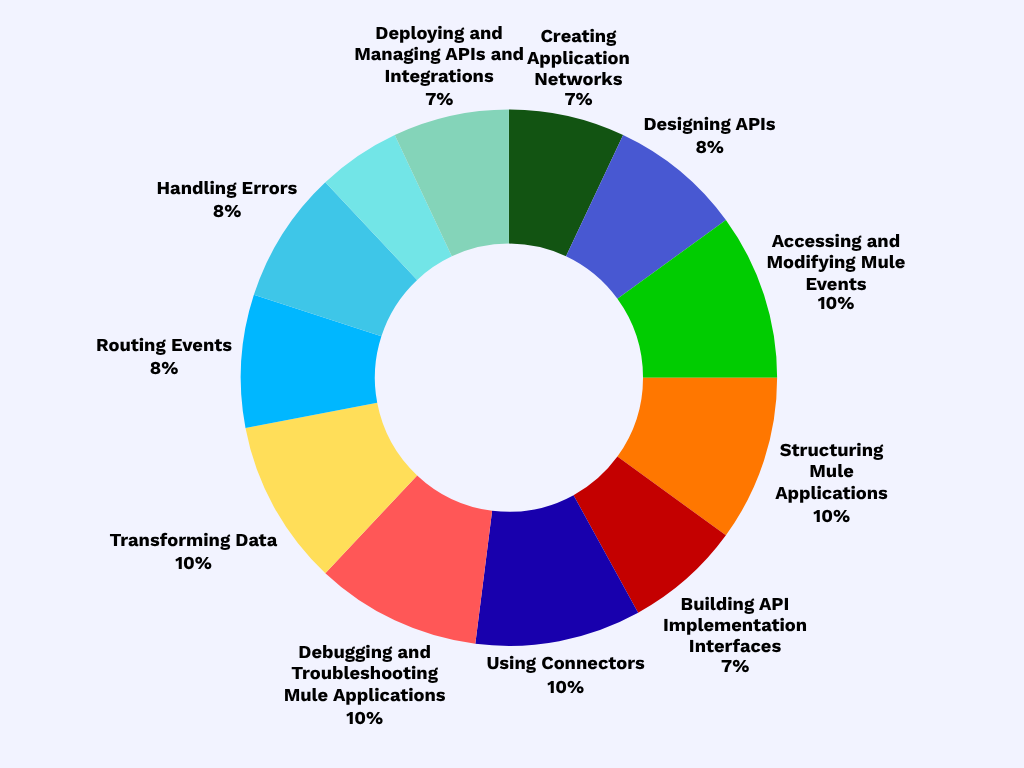
Mulesoft Developer Weighting Chart
Salesforce Certified MuleSoft Developer Certification Contents
The following sections describe the core topic areas of the certification and what candidates are expected to know.
Creating Application Networks
This topic includes the following objectives:
Identify core architectural concepts of the Application Network and modern APIs.
An application network connects applications, data, and devices through reusable APIs. Modern APIs provide well-defined interfaces that consumers can discover and use without needing to understand the underlying implementation. Candidates should understand how these interfaces support reuse, connectivity, and the delivery of new business capabilities.
Identify features of an API-led approach.
API-led connectivity organizes integration capabilities into System, Process, and Experience APIs. System APIs provide access to underlying systems, Process APIs combine data and implement business processes, and Experience APIs tailor information for particular consumers. Understanding these responsibilities helps developers identify suitable API boundaries and opportunities for reuse.
Understand and explain Business Analyst roles and responsibilities in different phases of the implementation lifecycle.
As the business analyst performs different tasks and roles throughout the implementation, understanding what is required at which stage is important to successful implementations. From requirements gathering to creating documentation to performing project management duties to achieving a successful rollout, the business analyst needs to understand what those roles and responsibilities are at all stages of the implementation lifecycle. Additionally, the business analyst must possess the following skills: Writing, ability to ask questions to elicit needs, perform analysis of data, recommend and implement solutions.
Identify features of MuleSoft’s recommended Operational Model (C4E).
A Center for Enablement (C4E) helps an organization adopt API-led connectivity through reusable assets, standards, and shared practices. It enables teams to discover and use existing capabilities while contributing new assets. Candidates should understand how a C4E supports collaboration, governance, and delivery across the organization.
Apply correct processors and syntax to consume RAML-based RESTful web services, and predict outcomes.
Consuming a RESTful service requires selecting the correct HTTP method, resource path, parameters, headers, and request body. A RAML specification describes the service contract and helps developers construct valid requests. Candidates should be able to interpret connector configurations and determine how responses affect the Mule event.
Designing APIs
This topic includes the following objectives:
Use REST API methods and resources.
REST APIs expose resources through paths and use HTTP methods to express operations on those resources. For example, GET retrieves information, while POST commonly creates a resource. Candidates should understand resource hierarchies and select methods that accurately represent the intended operation.
Define REST API parameters and responses.
An API specification describes the information a consumer must supply and the responses an operation can return. This includes parameter types, required values, request bodies, response bodies, and status codes. Clear definitions help consumers understand the API and allow implementations to follow a consistent contract.
Identify when and how to define query parameters versus URI parameters.
URI parameters typically identify a specific resource, such as an order ID in an order resource path. Query parameters commonly filter, sort, or control the results returned by an operation. Candidates should know how to define these parameters and interpret requests that contain them.
Accessing and Modifying Mule Events
This topic includes the following objectives:
Apply correct processors and DataWeave expressions to access and modify Mule event payloads, and predict outcomes.
The payload contains the main data processed by a Mule application, such as a JSON document or database result. Components such as Set Payload and Transform Message can replace or transform this data. Candidates should be able to follow a flow and determine the payload available after each operation.
Apply correct processors and DataWeave expressions to access and modify Mule event attributes, and predict outcomes.
Attributes contain metadata associated with a Mule message, such as HTTP headers, query parameters, or file information. They can be accessed using DataWeave expressions and can change when an operation produces a new message. Understanding this behavior helps developers preserve information needed later in a flow.
Apply correct processors and DataWeave expressions to access and modify Mule variables, and predict outcomes.
Mule variables store values associated with an event, such as identifiers or intermediate processing results. Set Variable, Remove Variable, and Transform Message can be used to manage these values. Candidates should distinguish Mule event variables from local DataWeave variables and understand their availability during processing.
Apply correct processors and DataWeave expressions to enrich Mule events using Mule 4 connector targets, and predict outcomes.
A connector operation normally places its result in the Mule message. Configuring a target allows the result to be stored in a variable while preserving the original message. Candidates should understand target and target value settings and predict which data remains available after the operation.
Structuring Mule Applications
This topic includes the following objectives:
Specify when and how to structure Mule applications into separate configuration and properties files, and predict outcomes.
Mule applications can use separate configuration files to organize flows, global elements, and related functionality. Properties files hold configurable values, such as endpoints and connection settings, which can be referenced through property placeholders. This structure improves maintainability and allows configuration values to vary between environments.
Specify when and how to pass events between flows and subflows using connectors and flow references, and predict outcomes.
Flow Reference passes an event to another flow or subflow within the same application and returns control to the caller. Connector-based communication can introduce different message and variable behavior. Candidates should understand how payloads, attributes, variables, and errors behave across these boundaries.
Building API Implementation Interfaces
This topic includes the following objectives:
Manually build API implementations from an API specification, RAML or not.
An API implementation can be built manually using components such as HTTP Listener, Choice, and Transform Message. The implementation must interpret incoming requests and return the expected responses. Candidates should understand how listener paths, HTTP methods, status codes, and response bodies support the API contract.
Predict the results of APIkit based upon a RAML specification.
APIkit uses an API specification to support request routing and validation. Generated implementation flows correspond to operations defined in the specification. Candidates should be able to determine which flow receives a request and identify the errors produced when a request does not satisfy the API contract.
Implement correct responses based on a RAML specification, either manually or with APIkit.
An API response should follow the status codes, media types, headers, and body structures defined in its specification. Developers must configure both successful responses and error responses appropriately. Candidates should be able to identify changes needed to make an implementation comply with the RAML contract.
Using Connectors
This topic includes the following objectives:
Apply correct processors and syntax to connect to databases, and predict outcomes.
The Database Connector provides operations for retrieving and modifying database records. Developers configure connection details and use SQL statements with input parameters to perform the required operations. Candidates should understand parameterized queries, operation outputs, and how database results become available within a Mule flow.
Apply correct processors and syntax to connect to files or FTP servers, and predict outcomes.
File and FTP connectors allow applications to interact with local or remote files. Operations include listing, reading, writing, moving, and deleting files. Candidates should understand connection settings, file paths, matching rules, and the payload and attributes returned by the selected operation.
Apply correct processors and syntax to retrieve and combine data in the middle of a flow, and predict outcomes.
A flow may retrieve additional information from a database, API, or file while processing an existing event. Target variables can preserve the incoming message while storing retrieved results. DataWeave expressions can then combine the original information with the additional data to produce the required output.
Processing Records
This topic includes the following objectives:
Apply correct processors and syntax to process individual records in a collection using For Each scopes, and predict outcomes.
For Each applies a sequence of processors to the items in a collection. Candidates should understand collection expressions, batch size settings, variable propagation, and error behavior. They should also be able to distinguish the payload used inside an iteration from the payload available after the scope.
Apply correct processors and syntax to process individual records in a collection using batch scopes, and predict outcomes.
A Batch Job splits input data into records and processes them through batch steps. Filters determine which records enter a step, while a Batch Aggregator can group records for an operation. Candidates should understand record-level processing, failure handling, and the information available when the job completes.
Apply correct processors and syntax to process individual records in a collection using database listeners, and predict outcomes.
A database listener can trigger a flow when records meet its configured polling criteria. Connection details, polling frequency, and watermark settings affect which records are retrieved. Candidates should understand how listener configuration supports incremental processing and how changes to the selected records affect subsequent executions.
Apply correct processors and syntax to persist data between flow executions.
Object Store can retain information that must be available across separate flow executions, such as processing checkpoints or previously handled identifiers. Developers can store, retrieve, and remove values using keys. Candidates should understand persistence settings, expiration, and how to handle missing or existing keys.
Transforming Data
This topic includes the following objectives:
Convert between output types and data types using DataWeave.
DataWeave transforms data between formats such as JSON, XML, CSV, and Java. It also converts values between types, including strings, numbers, and dates. Candidates should distinguish the output format from the data type and predict how transformation settings affect the resulting payload.
Predict the result of core DataWeave functions.
Core DataWeave functions support common operations on arrays, objects, strings, and other values. Functions such as map, filter, and pluck help reshape and select data. Candidates should be able to interpret function inputs, lambda expressions, and return values to determine the result of a script.
Apply correct syntax to write DataWeave transformations to coerce, format, order, and filter data, and predict outcomes.
DataWeave provides operators and functions for converting types, formatting values, sorting collections, and selecting matching records. For example, a transformation may convert a string to a number before sorting or calculating a result. Candidates should recognize valid syntax and identify how these operations affect output.
Call Mule flows from a DataWeave script.
The Mule lookup function allows a DataWeave script to invoke a flow and use its result. Candidates should understand the flow name, input value, and returned payload, including the restriction that lookup does not invoke subflows. They should also recognize Flow Reference with a target variable as an alternative approach.
Define, use, and reuse DataWeave modules, functions, and variables, and predict outcomes.
DataWeave variables hold intermediate values, functions encapsulate reusable logic, and modules organize definitions that can be imported into other scripts. Candidates should understand declaration and import syntax, parameter passing, and scope. These features reduce duplication and make transformations easier to maintain.
Routing Events
This topic includes the following objectives:
Apply correct processors and syntax to route messages using DataWeave conditions within a Choice router, and predict outcomes.
A Choice router evaluates conditions and executes the first route whose condition is true. An otherwise route can handle events that do not match any condition. Candidates should be able to interpret DataWeave conditions and determine which processors run for a given event.
Apply correct processors and syntax to scatter and gather messages, and predict outcomes.
Scatter-Gather sends an event through multiple routes in parallel and combines their results. Candidates should understand the structure of the aggregated output and how route failures affect processing. An unhandled route failure results in a composite routing error that can include successful results and failed-route details.
Apply correct processors and syntax to validate Mule events, and predict outcomes.
The Validation module checks whether data meets defined conditions, such as required values, valid formats, or acceptable ranges. A failed validation raises an error that can be handled by the application. Candidates should identify suitable validators and determine whether processing continues for a given input.
Handling Errors
This topic includes the following objectives:
Apply correct processors and syntax to implement global error handlers, and predict outcomes.
Global error handlers define reusable error-handling behavior that can be referenced by flows or configured as an application default. They help maintain consistent responses and logging across an application. Candidates should understand how handlers are referenced and when a global handler applies.
Apply correct processors and syntax to implement On Error Continue and On Error Propagate handlers, and predict outcomes.
On Error Continue handles an error and treats its owning flow or scope as successful. On Error Propagate handles the error and passes it to the caller as a failure. Candidates should understand where execution resumes and how the selected handler affects the returned event.
Apply correct processors and syntax to combine multiple error handlers, and predict outcomes.
An error handler can contain multiple On Error components with different error types or conditions. Mule evaluates them in order and uses the first matching handler. Candidates should understand why specific handlers should generally precede broader handlers and predict which handler processes an error.
Apply correct processors and syntax to implement Try scopes, and predict outcomes.
A Try scope groups processors and provides local error handling for those operations. If an error occurs, processing stops within the affected sequence and the matching handler executes. Candidates should determine whether the error is handled locally or propagated and where processing resumes afterward.
Apply correct processors and syntax to map custom errors, and predict outcomes.
Error mapping translates an operation’s error into a custom application error type. This allows the application to distinguish failures that require different handling, even when they originate from similar operations. Candidates should understand custom namespaces, error types, and how mapped errors match configured handlers.
Debugging and Troubleshooting Mule Applications
This topic includes the following objectives:
Identify root causes for errors when debugging Mule applications, and predict outcomes.
Anypoint Studio provides debugging tools for inspecting events as they move through a flow. Breakpoints help developers examine payloads, attributes, and variables, while logs provide details about runtime errors. Candidates should use this information to identify problems such as incorrect expressions, configuration errors, missing dependencies, and failed connections.
Deploying and Managing APIs and Integrations
This topic includes the following objectives:
Deploy applications to CloudHub.
CloudHub provides a managed environment for running Mule applications. Deployment involves selecting an application package, configuring runtime settings and properties, and checking deployment status. Candidates should understand how application configuration and logs help identify and resolve problems that prevent an application from starting successfully.
Manage APIs using separate proxies and autodiscovery.
An API proxy can provide a managed entry point in front of an API implementation. Autodiscovery links a Mule application to its API instance in API Manager so that management capabilities and policies can apply. Candidates should understand the purpose and configuration of each approach.
Manage API policies.
API policies apply management and security controls to API traffic without requiring the same logic to be implemented separately in each application. Examples include client ID enforcement and rate limiting. Candidates should understand policy configuration, application contracts, SLA tiers, and how policies affect incoming requests.